
Understand Glass As A Process
Glass production becomes easier to follow when batching, melting, forming, annealing, and inspection are studied as connected stages rather than isolated technical terms.
Browse Glass Process Notes
Follow Material Changes
Trace how a glass batch changes through heating, refining, forming, and controlled cooling instead of memorizing stage names alone.
Compare Before Concluding
Use forming diagrams, finished samples, and process observations to compare possibilities before assigning a cause to a defect.
Keep Practice Safety-Focused
Build understanding through diagrams, photographs, safe samples, and demonstrations rather than work with industrial heat.
LEARNING THROUGH PROCESS OBSERVATION
Glass terminology becomes more useful when every term is connected to a physical change. Instead of treating silica, cullet, viscosity, refining, forming, and annealing as separate definitions, learners trace where each belongs in the path from batch materials to finished glass.
Practice also emphasizes careful observation. Process diagrams, temperature-and-viscosity examples, defect photographs, safe samples, and simple dimensional checks help learners notice how bubbles, inclusions, distortion, thickness, and edge quality relate to different stages without jumping to a single explanation.
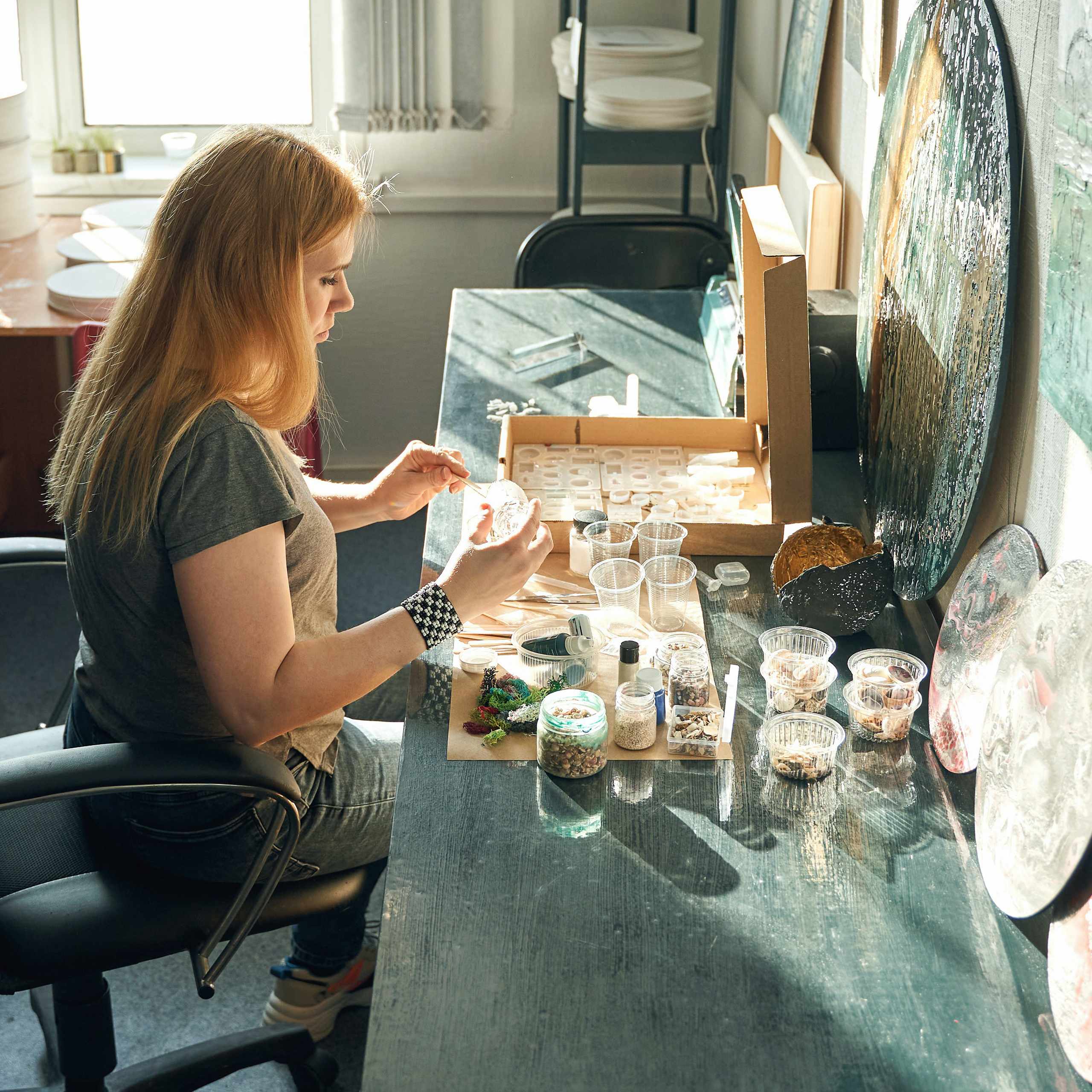
From glass batch to inspection
HABITS BEHIND CAREFUL PROCESS STUDY
TRACE EACH STAGE
Keep batching, melting, refining, forming, annealing, and inspection in their correct production sequence.

OBSERVE BEFORE DIAGNOSING
Check surfaces, bubbles, inclusions, thickness, edges, and distortion before suggesting where a defect began.

CONNECT HEAT TO BEHAVIOR
Relate temperature and viscosity to how glass moves, forms, and responds during controlled cooling.
From Diagrams To Finished Glass
Practice moves between process diagrams, material behavior, forming comparisons, and finished-sample inspection so each observation has a clear production context.
Map Material Flow
Sketch simple production paths and identify what happens to the glass before, during, and after forming.
Compare Forming Processes
Examine pressing, blowing, drawing, and float forming by following how molten glass is shaped and cooled.
Check Finished Samples
Use a repeatable inspection sequence for surfaces, thickness, edges, bubbles, inclusions, and visible distortion.
Find Your Starting Point
Clarify which glass-production topics, diagrams, safe samples, or basic inspection exercises make sense for your current level.